

EVAN SIMON-LEACK: Killing Yourself
Author feature — Issue #12
A shining facility stands in the middle of a desert.
You approach it on your rusted motorcycle, plumes of poison sand blowing around.
You pray you have enough to pay the scientists inside.
These researchers can’t give you much. They can’t un-destroy the world, or give you all those dead friends and loved ones back. But their machines can grow something you desperately need: company.
Out of the only resource that you have.
Yourself.
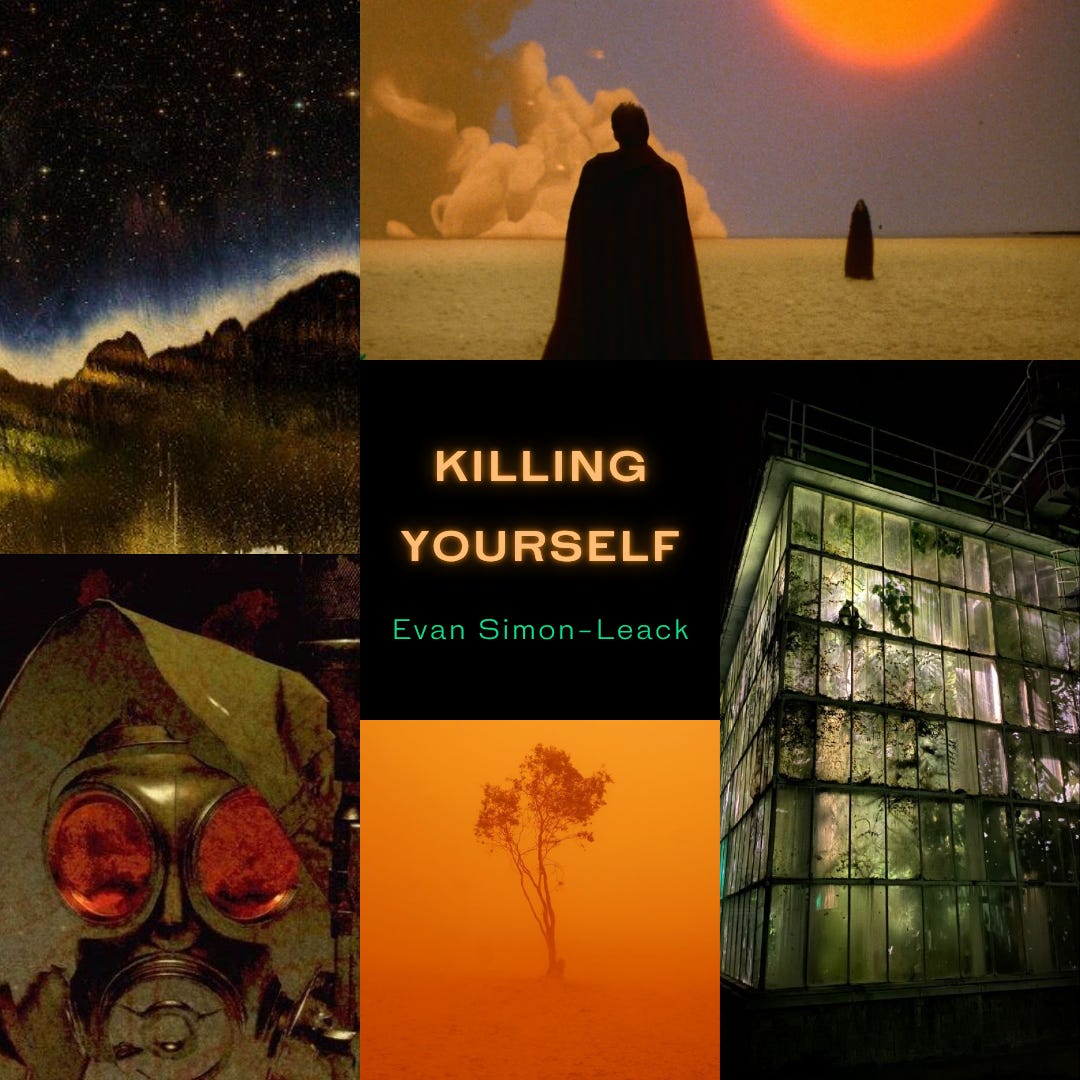
Evan Simon-Leack’s story “Killing Yourself” appears in the current issue of Radon Journal. It features a dystopian environment where, much like Mad Max, the world has been desertified, and the survivors struggle to get by. But where the violence in Mad Max is external and interpersonal — guys ramming and battling each other — Evan imagines that violence turned inward: People slowly cracking under the weight of isolation and loneliness.

Jack, the protagonist, opts for an experimental procedure that will create an “aspect”: a clone of himself to keep him company on his isolated greenhouse compound. Everything goes according to plan, except for one crucial detail — Jack hasn’t disclosed his suicidal ideation. This leads to terrifying consequences when his clone comes awake.
Jack’s lonely life as a subsistence farmer is one of the most interesting parts of the story. We get glimpses of the catastrophe that drove people into into shelters, and how it was probably precipitated by industrialists. Predictably, these people were the first ones to flee when Earth became uninhabitable.
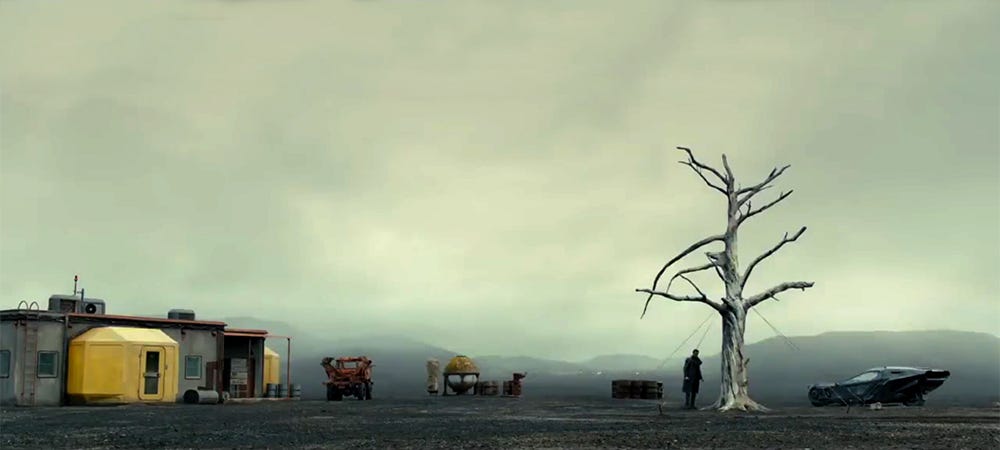
Even more perversely, the economy of post-apocalypse earth continues to serve the purposes of capitalist extraction. Jack has no money — the economy has collapsed — but he does have plant genomes, which are a kind of currency.
“We have a sliding-fee scale… What all do you grow?”
Jack told her the entire list. Described a few in more detail, when prompted.
Dr. Mizrahi typed something on the desk computer. After a moment, she said, “[The] peaches you describe are a strain whose genome was lost and would be of value to our off-world benefactors. We will accept samples as payment.”
“These benefactors will fly down[?]”
“Goodness, no.” Dr. Mizrahi laughed. “We’ll sequence the DNA and transmit it to them. In return, they’ll strap goods to an unmanned rocket and point it in our direction.”
It’s darkly funny — as we saw during COVID, it’s a recurring pattern for the rich to malign, defund, and sabotage scientists, then — when the inevitable crisis hits — retroactively hoard the benefits of said researchers for themselves.
Interview
Evan Simon-Leack writes science fiction from California, and occasionally branches into speculative horror or dark fantasy. He (his words, not ours) “takes out his life of chronic illness out on characters who probably don’t deserve it” and explores how chronic health conditions affect people and their relationship to the world.
In our interview, Evan talks about how “Killing Yourself” articulated some very dark emotions, and how the post-apocalyptic desert serves as a way to explore themes of isolation.
He also discusses how societal trends are leading to some darker directions in sci-fi horror, and how he’s written more horror as a response to ongoing stress. “I needed something other than myself to fear,” he quips.

Turntable
Head to your bathroom. Bring your device. Close the door. Do you have a proper echo? Good.
Evan Simon-Leack’s selection is the perennial classic “The Sound(s) of Silence” by Simon & Garfunkel. “I neurotically sing it over and over in the shower,” says Evan. And we’d like to point out that Paul Simon composed it in his bathroom as well.
Thanks for reading!
Radon is an award-winning journal publishing sci-fi prose and poetry relating to anarchism, transhumanism, and dystopia. For more work, our latest issues, and information about submitting, click below.
For weekly features of our authors, editor roundtables, and genre commentary, subscribe here on our Substack.